Refresh Forecasting
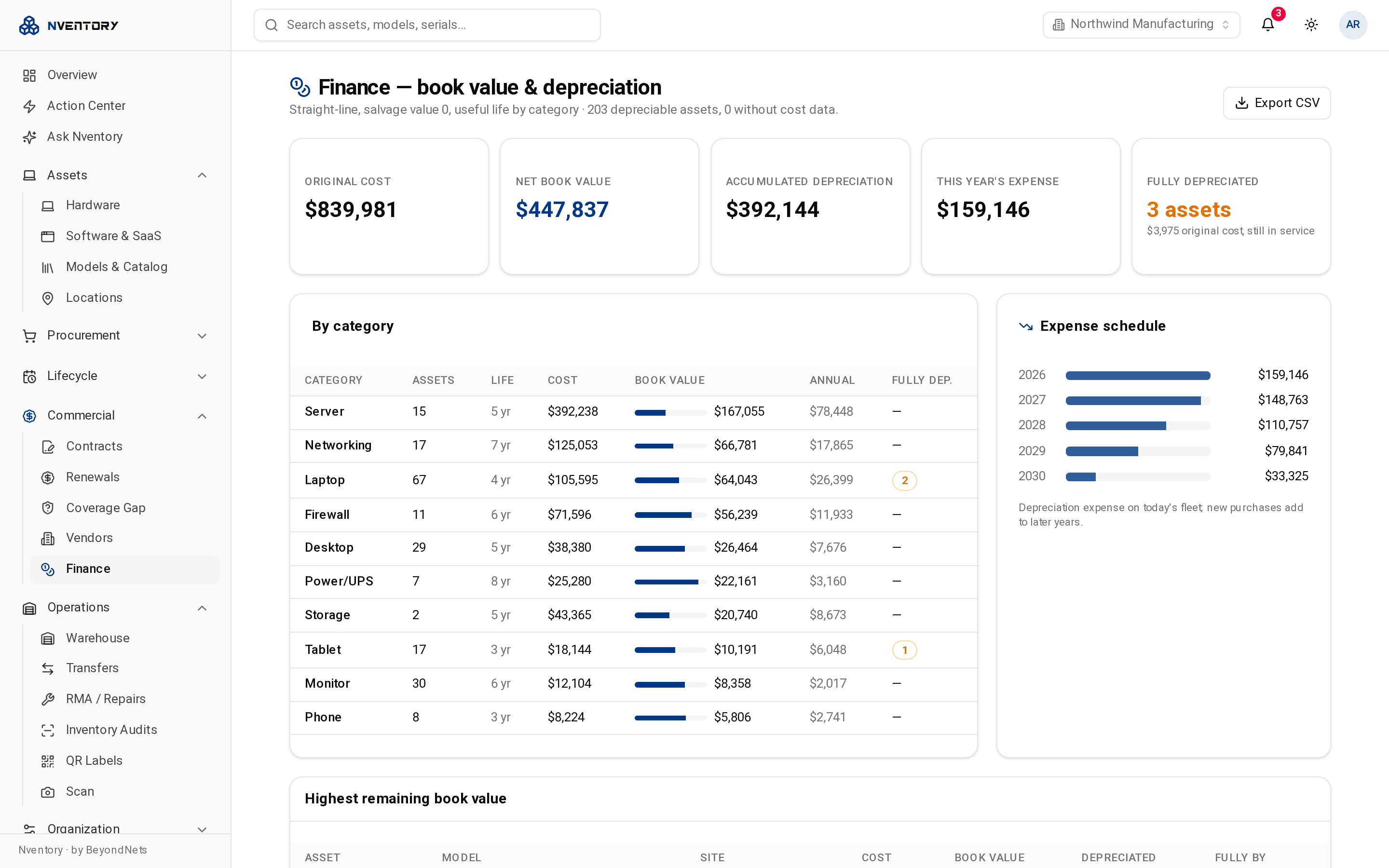
Project replacement spending by year using recorded lifecycle dates and costs. Give leadership a clearer basis for the next budget.
See the product view
nventory.beyondnets.comDemo

Nventory gives IT, operations, procurement, and finance a single view of the technology estate — from purchase to retirement.
Track hardware, software, certificates, warranties, contracts, renewals, end-of-life dates, locations, users, vendors, RMAs, and costs in one platform. Then turn that information into prioritized, assigned work before deadlines become problems.
Free for up to 500 combined inventory items. Certificates do not use your item allowance.
All screenshots show the Nventory demo environment with sample data.
500 items free
No credit card required
6-hour monitoring
Certificate checks on paid plans
Full lifecycle
Purchase order to retirement
1 platform
IT, Ops, Procurement and Finance
Most organizations have asset information spread across spreadsheets, purchasing systems, vendor portals, invoices, contracts, service desks, and individual IT teams.
The result is a familiar set of questions that are surprisingly difficult to answer:
Nventory brings those answers together and turns them into action.
Nventory maintains a complete lifecycle record for every technology asset.
Capture purchase orders, vendors, quantities, pricing, and procurement history.
Receive equipment into inventory, record serial numbers, and create asset records automatically.
Assign equipment to users, sites, divisions, warehouses, or specific locations.
Track warranty, support coverage, software, contracts, transfers, audits, repairs, and RMAs throughout the asset's life.
Identify approaching warranty expirations, vendor end-of-support dates, contract renewals, coverage gaps, and upcoming replacement costs.
Maintain the complete history of an asset through replacement and retirement.
One lifecycle. One record. Full history.
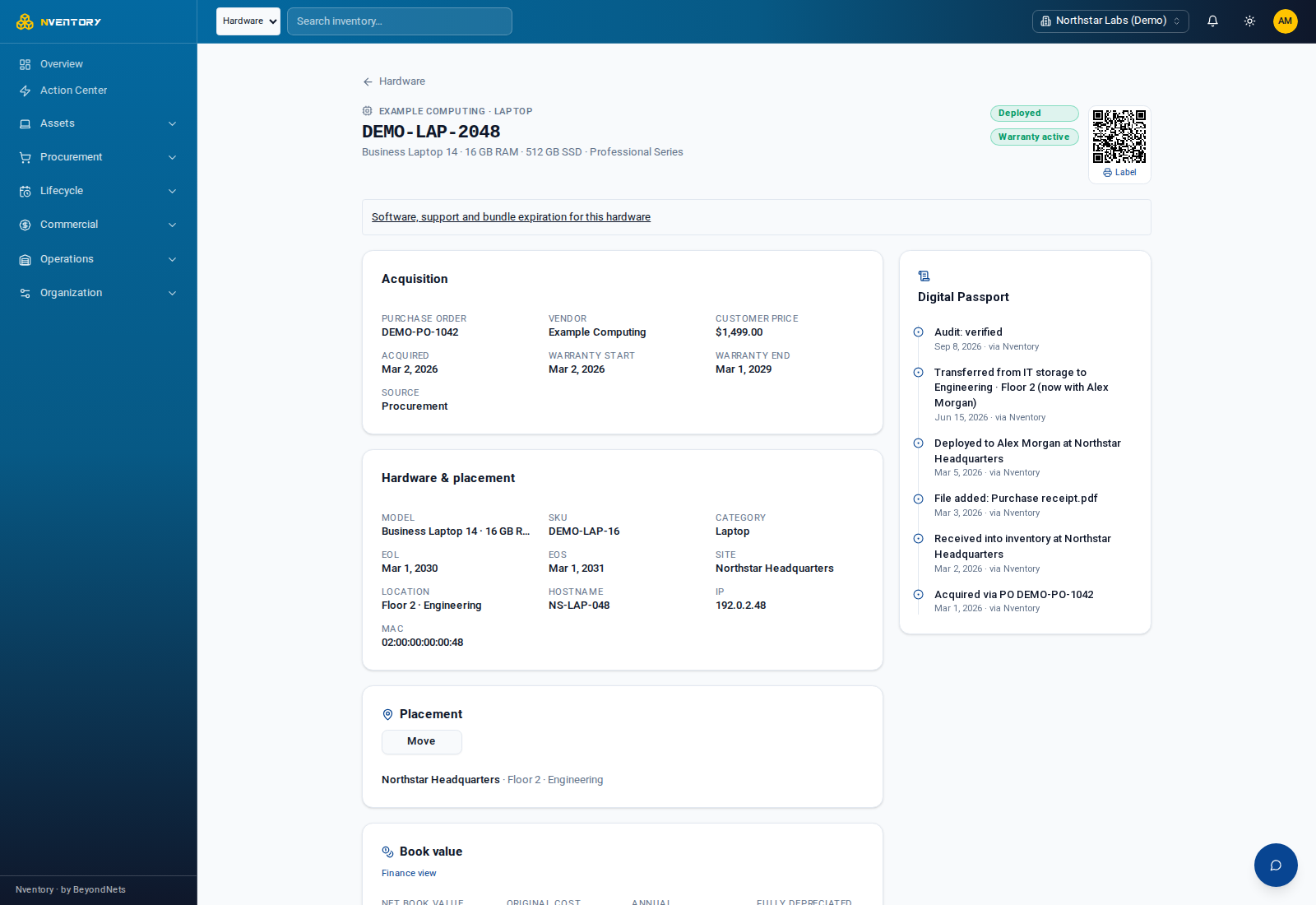
Every asset gets its own digital passport.
Instead of searching across systems to understand a device, Nventory brings its entire history together in one place.
From the day equipment arrives until the day it is retired, Nventory maintains its story.
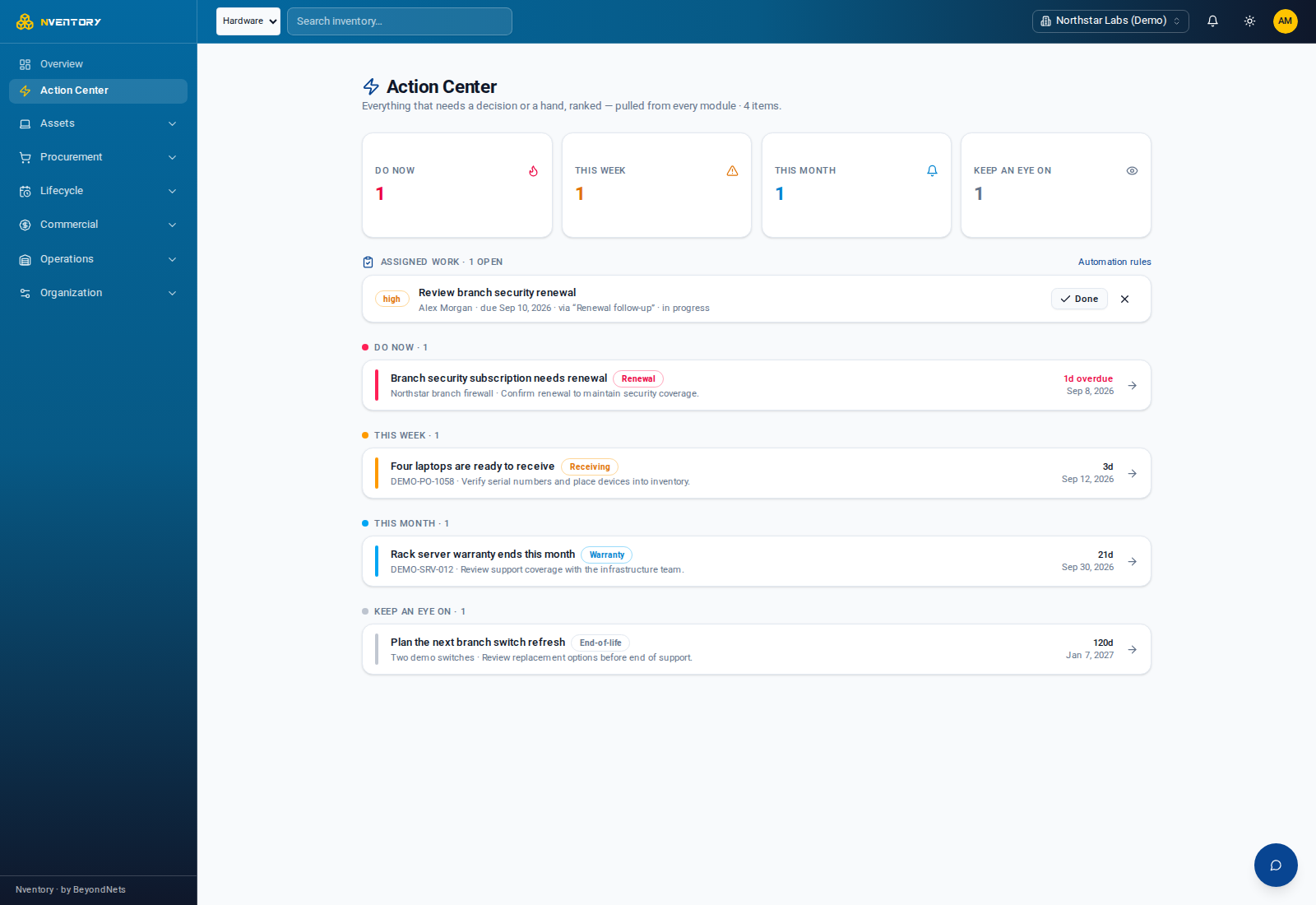
Nventory continuously evaluates the technology estate and surfaces what requires attention.
Instead of making IT teams search through dashboards and reports, the Action Center organizes work into:
Nventory can surface:
Every action links directly to the record that needs attention.
No more hunting for the problem.
Turn lifecycle data into planning across warranties, contracts, coverage, software and budgets.
Project replacement spending by year using recorded lifecycle dates and costs. Give leadership a clearer basis for the next budget.
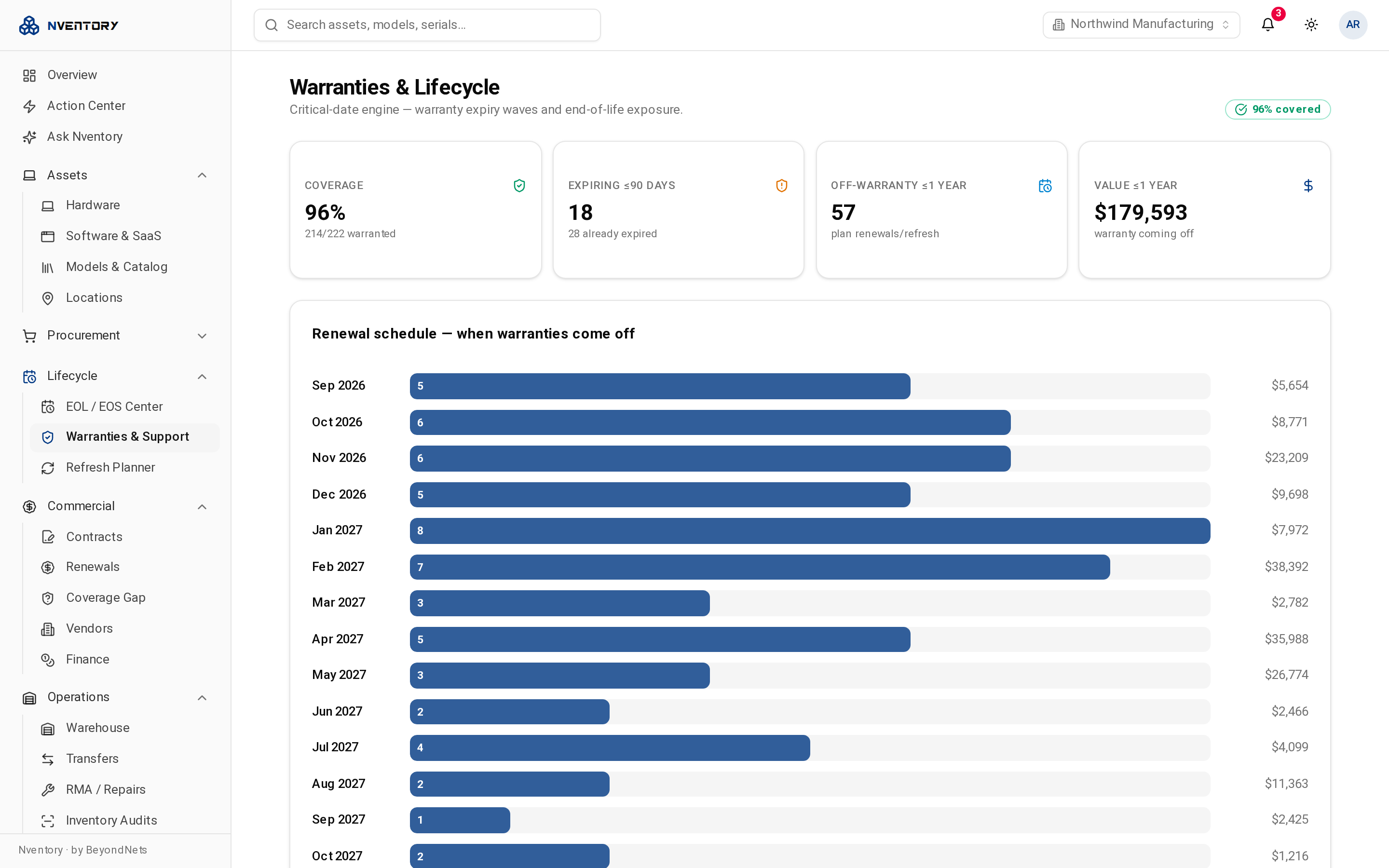
See what is approaching warranty expiration or vendor end of support, and what belongs in your next refresh plan.
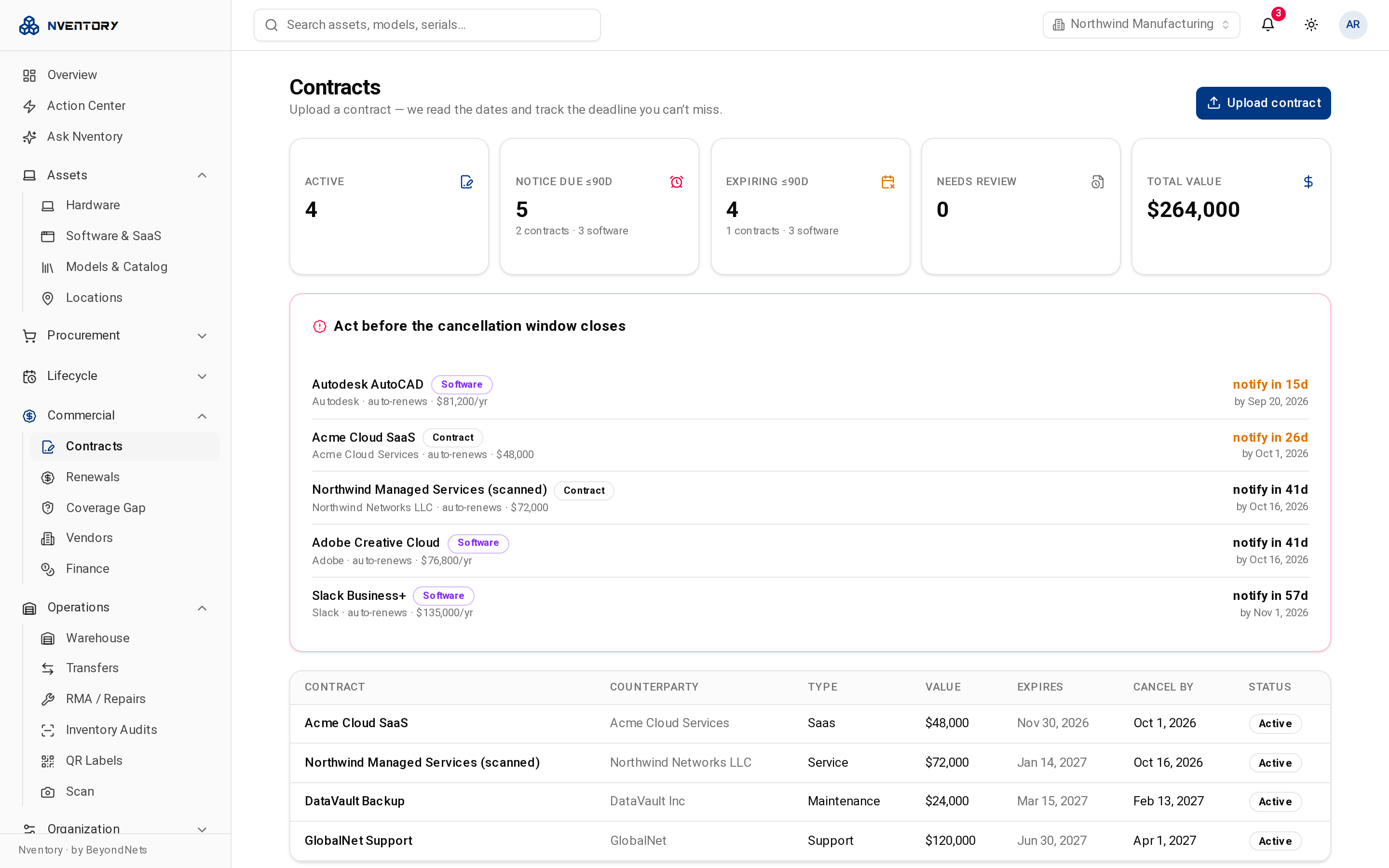
Connect contract terms, renewal dates, cancellation notices and value to the assets they cover.
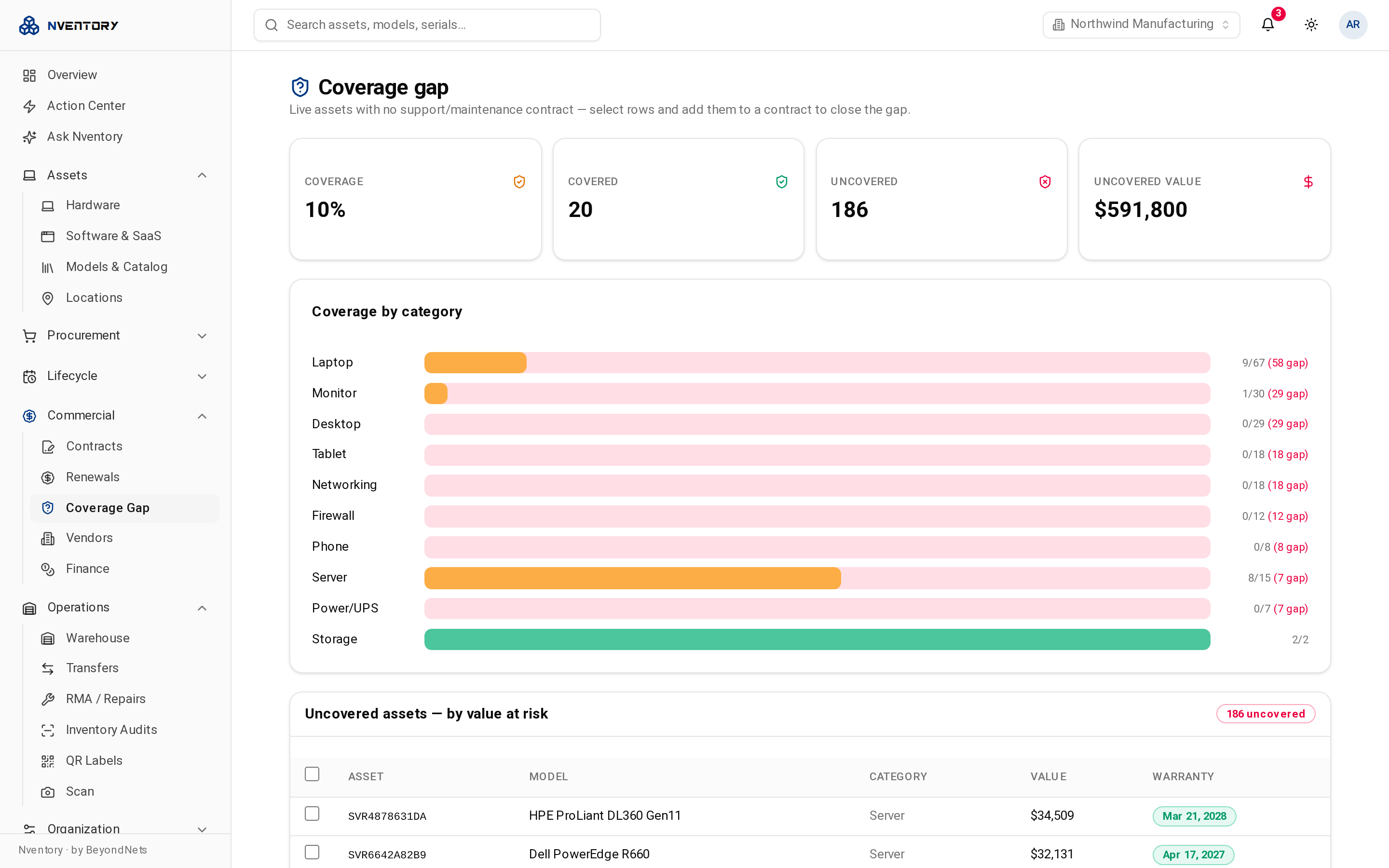
Find assets without recorded support or maintenance coverage and prioritize review before a critical device fails.
Track purchased and assigned seats, utilization, spend and renewal dates. Find unused capacity and upcoming cancellation deadlines.
Turn uploaded documents into proposed contract fields. A person reviews and confirms each extraction before it becomes authoritative.
Purchasing equipment shouldn't create another manual data-entry project. Connect the purchase to the asset's useful life.
Find matching records as you type, or describe what you need—for example, a laptop with 16 GB of RAM.
Track the device and its bundled security subscription or support term separately. The license may expire while the hardware remains useful.
Select the first item, hold Shift and select the last to include everything in between. Receive the selected merchandise together.
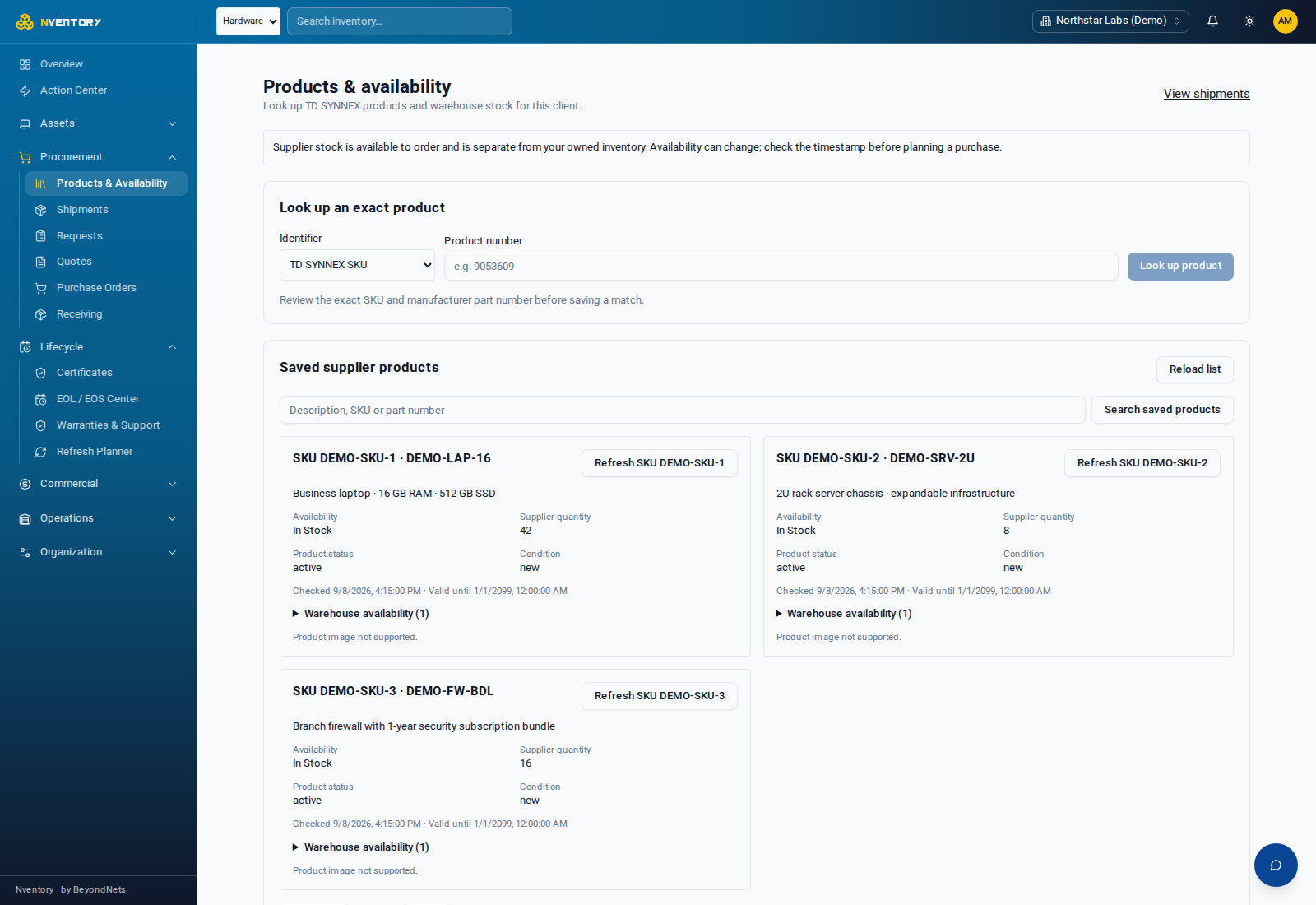
Look up exact supplier SKUs or manufacturer part numbers, review warehouse stock snapshots and save the selected product. Verified invoices provide shipment references and tracking numbers.
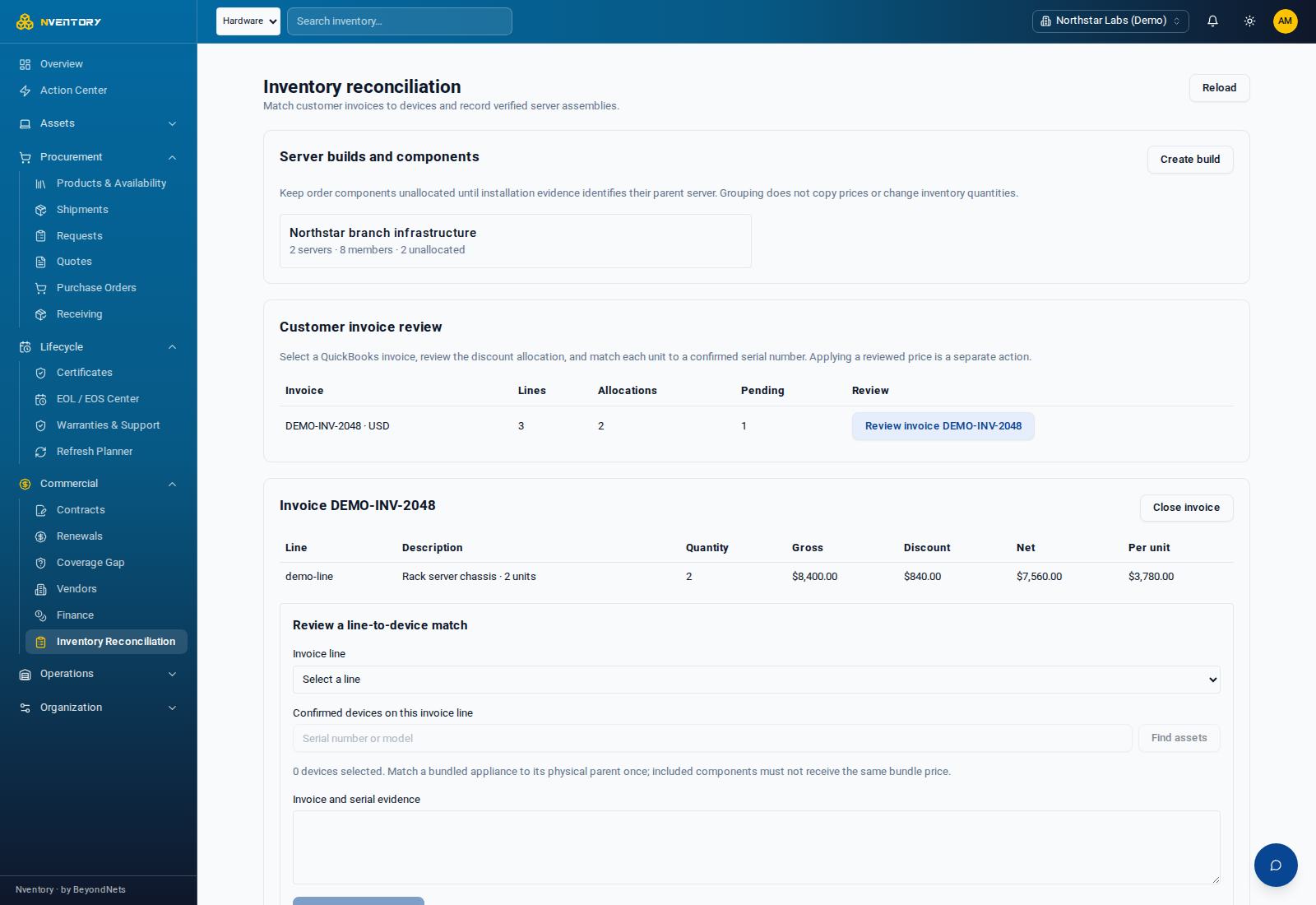
Match invoice lines to serial evidence, allocate discounts and apply a verified customer price. Group confirmed server components without duplicating customer cost.
Keep traceability from the original purchase decision through the useful life of the technology.
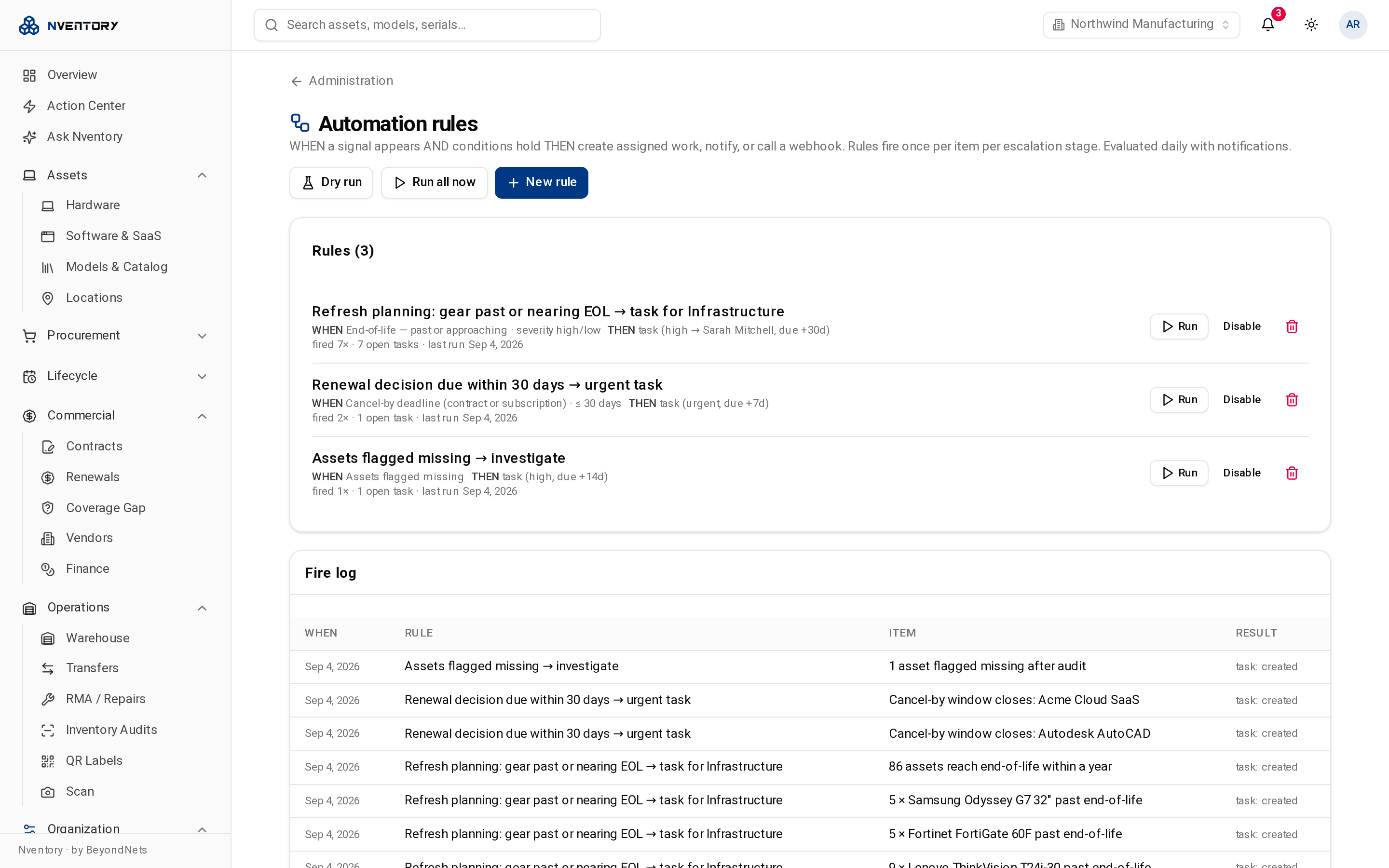
Organize day-to-day work and use automation to follow up on lifecycle events.
Organize assets by Organization → Division → Site → Location → User, across offices, warehouses, branches and remote employees.
Track available inventory and identify equipment sitting unused for too long.
Move equipment into service and assign it to the appropriate user and location.
Follow equipment as it moves between users, departments and facilities.
Manage repair cases, replacements and serial-number swaps while preserving asset history.
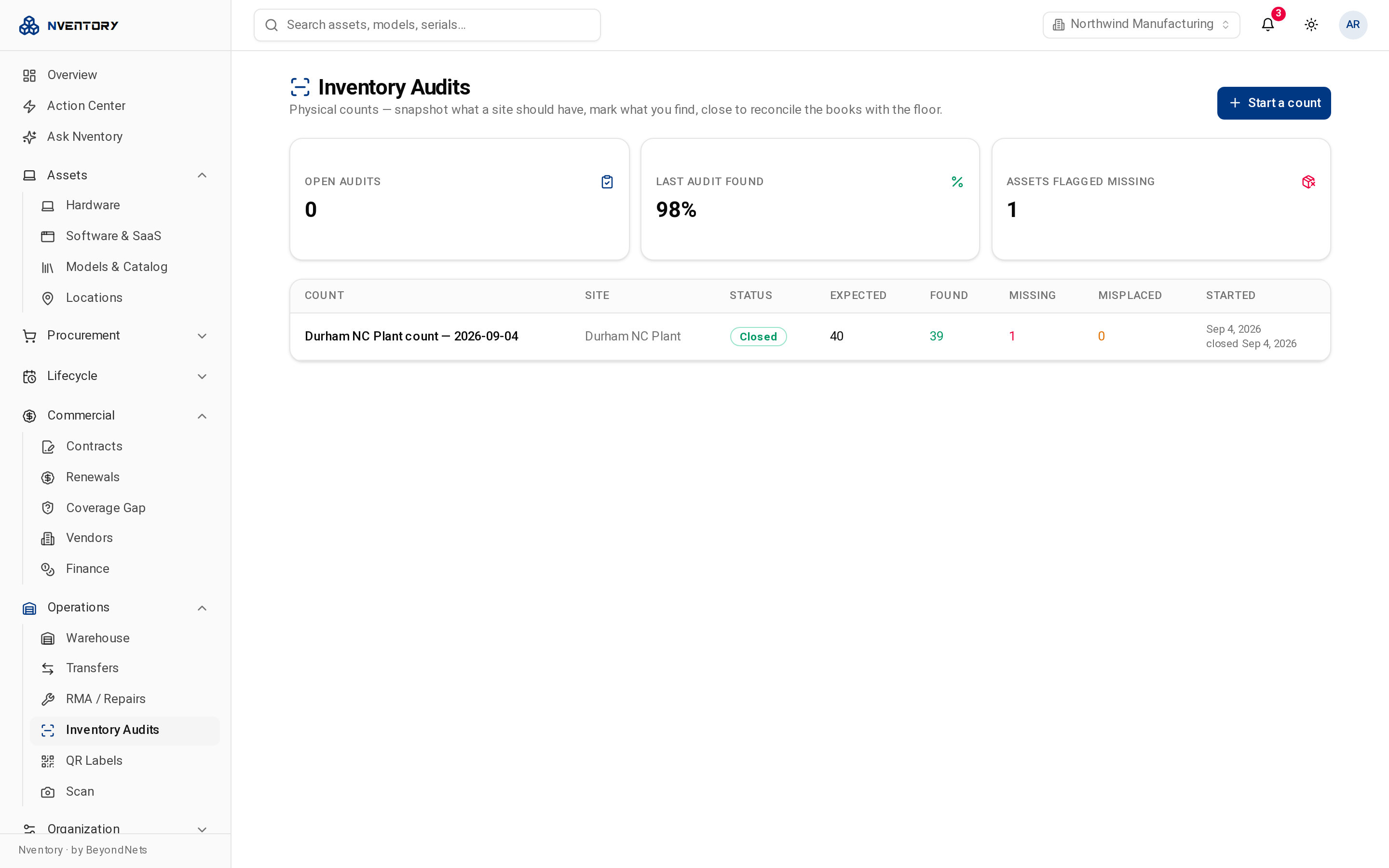
Validate what is present and flag missing equipment. Print QR labels and count a site using a phone camera.
Test rules before activation. Automated actions are logged for accountability.
Bring lifecycle events to your team when they become more urgent, rather than repeating the same warning every day.
In-app notifications • Email • Slack • Microsoft Teams • Secure Webhooks
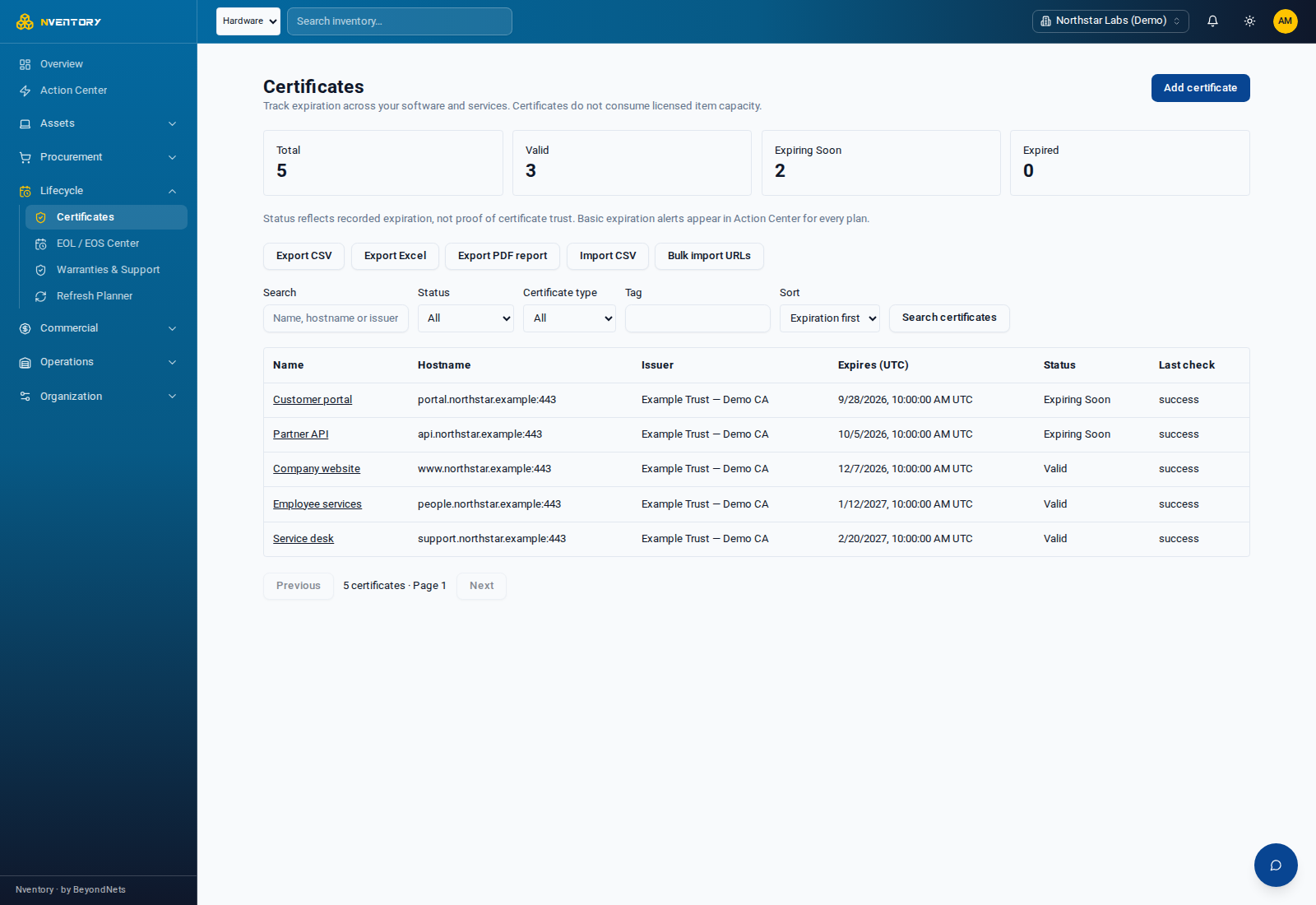
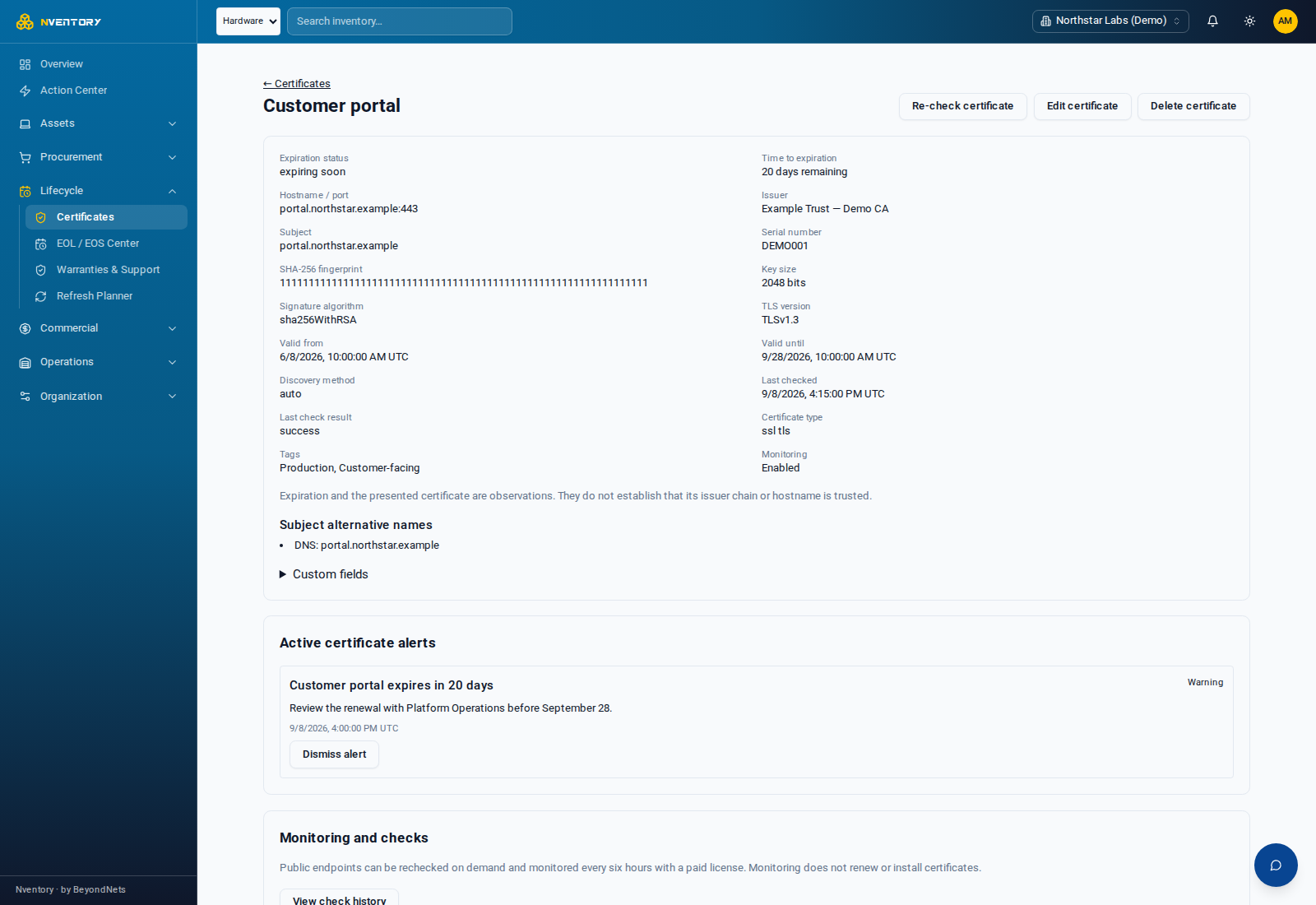
Track expiration, owners and certificate evidence in Lifecycle → Certificates.
Free users can add records manually, import CSV, export CSV, Excel or PDF, and receive basic in-app expiration alerts.
Paid plans add public certificate discovery, bulk URL previews and monitoring every six hours. Review the results before saving them.
Enterprise adds custom alert thresholds, public trust-chain checks and internal CA records.
Certificates do not count toward the 500-item free allowance.
Monitoring detects certificate changes and renewals; it does not renew or install certificates. Private hostnames can be tracked manually.
Understand asset value, lifecycle risk, refresh requirements, upcoming renewals, and future technology spending.
Know where equipment is, who has it, what's covered, what needs repair, and what requires action.
Connect purchasing decisions directly to the assets and contracts they create.
Understand technology spend, renewal obligations, vendor relationships, software waste, and upcoming capital requirements.
Nventory turns operational asset data into decision-ready reporting across:
Filter, analyze, and export when deeper analysis is required.
Nventory was designed as a multi-tenant enterprise platform from the beginning.
Organizations can manage multiple divisions, sites, locations, vendors, contracts, users, and thousands of technology assets while maintaining strict separation between client environments.
For managed service providers, Nventory provides centralized management across customer environments without combining customer data.
Nventory uses AI selectively — not as a replacement for accountable business decisions.
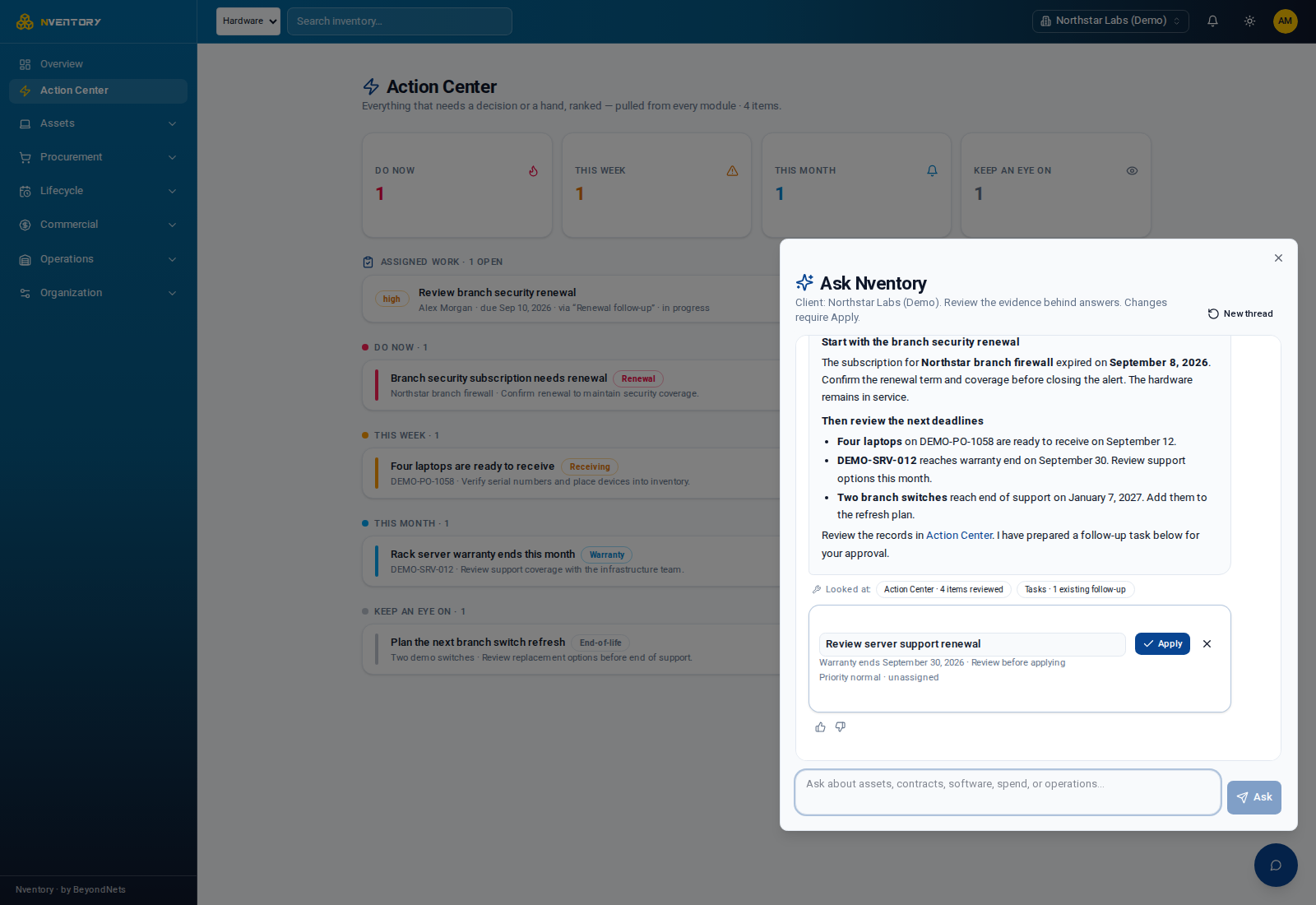
AI assists with document understanding, contract extraction, lifecycle matching, and natural-language interaction with asset data through Ask Nventory — which answers only from your own data, links every figure to its source, and proposes changes for a person to apply.
Critical dates and extracted contract information remain review-gated before becoming authoritative.
Lifecycle calculations, deadline escalation, forecasting, and workflow rules remain explainable and auditable.
For BeyondNets-hosted AI capabilities, sensitive document processing can remain within the BeyondNets-controlled environment rather than being sent to public AI services.
Know what you own. Know how exposed it is.
Nventory and NCERIO solve two different sides of the technology-management problem.
Together, they create a more complete picture of the technology estate.
Nventory knows what should exist.
NCERIO knows what actually exists and how it is configured.
Reconciliation between the platforms can help identify unmanaged, unknown, missing, or incorrectly recorded technology.
Choose the capacity and capabilities your organization needs.
Core hardware, software and contract inventory; manual certificate tracking, import/export and basic in-app alerts. Certificate records do not consume the allowance.
Expand item capacity and unlock procurement, commercial and lifecycle workflows, public certificate discovery, six-hour monitoring, API access and configured outbound alerts.
Paid capabilities with custom certificate thresholds, public trust-chain checks and internal CA certificate records.
The free allowance combines counted assets, software licenses, contracts and tracked entitlements. Free use includes company-name and logo permission under the Nventory agreement. Supplier workflows require their corresponding connections; outbound alerts require configured channels.
Submit a free signup request. BeyondNets reviews it and contacts you to arrange activation. You can begin adding records once your workspace is activated.
Use CSV import for supported inventory records and certificates. Certificate exports to CSV, Excel and PDF are included on Free; other exports depend on the record type and plan.
Yes. Organize divisions, sites, locations and users while keeping customer environments separate.
Your records are retained. Access returns to the applicable allowance and features; records over the limit are hidden from company views and search. Adding capacity restores access to those records.
No. Certificate records do not consume licensed item capacity.
No. It monitors public endpoints and alerts on certificate changes and expiration. Private hostnames can be tracked manually; hosted discovery does not scan private networks.
Yes. API access is available on paid plans.
Yes. Nventory supports management across customer environments while keeping their records separate.
Verified supplier invoices provide shipment references, carrier names and tracking numbers. Live carrier delivery events and supplier product images are not currently connected.
Asset management shouldn't end with knowing that a device exists.
Nventory helps organizations understand the ownership, location, cost, coverage, lifecycle, risk, and next decision associated with their technology.
So instead of asking: “What do we have?”
your team can answer: What needs our attention next?
Your business deserves a network that grows with you. Let BeyondNet take your digital infrastructure beyond limits.
 8 The Green #24394 Dover, DE, 19901, United States